Battle of the Coral Sea, 7-8 May 1942 --The Events of 7 May 1942
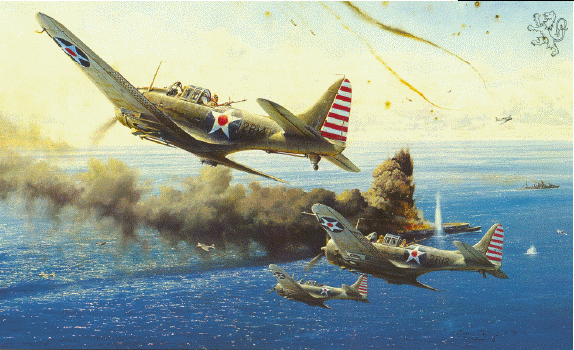
 The Battle of Coral Sea by Robert Taylor (Picture from Dave's Warbirds site)
The first day of the carrier battle of Coral Sea, 7 May 1942, saw the Americans searching for carriers they knew were present and the Japanese looking for ones they feared might be in the area. The opposing commanders, U.S. Rear Admiral
Frank Jack Fletcher and Japanese Vice Admiral Takeo Takagi and Rear Admiral Tadaichi Hara, endeavored to "get in the first blow", a presumed prerequisite to victory (and to survival) in a battle between heavily-armed and lightly-protected aircraft carriers. However, both sides suffered from inadequate work by their scouts and launched massive air strikes against greatly inferior secondary targets, which were duly sunk, leaving the most important enemy forces unhit.
Japanese scouting planes spotted the U.S. oiler
Neosho (AO-23) and her escort, the destroyer USS
Sims (DD-409), before 8AM, in a southerly position well away from Admiral Fletcher's carriers. Reported as a "carrier and a cruiser", these two ships received two high-level bombing attacks during the morning that, as would become typical of such tactics, missed. However, about noon a large force of dive bombers appeared. As was normal for that type of attack, these did not miss. Sims sank with very heavy casualties and Neosho was reduced to a drifting wreck whose survivors were not rescued for days.

USS Sims (DD-409) (Boston - 1940)

USS Neosho burning after Japanese attack (7 May 1942)
Meanwhile, a scout plane from USS Yorktown (CV-5) found the Japanese Covering Group, the light carrier Shoho and four heavy cruisers, which faulty message coding transformed into "two carriers and four heavy cruisers". Yorktown and USS Lexington (CV-2) sent out a huge strike: fifty-three scout-bombers, twenty-two torpedo planes and eighteen fighters. In well-delivered attacks before noon, these simply overwhelmed the Shoho, which received so many bomb and torpedo hits that she sank in minutes. Her passing was marked by some of the War's most dramatic photography.

Adding to the confusion, if not to the score, Japanese land-based torpedo planes and bombers struck an advanced force of Australian and U.S. Navy cruisers, far to the west of Admiral Fletcher's carriers. Skillful ship-handling prevented any damage. Australia-based U.S. Army B-17s also arrived and dropped their bombs, fortunately without hitting anything.
All this had one beneficial effect: the Japanese ordered their Port Moresby invasion force to turn back to await developments. Late in the day, they also sent out nearly thirty carrier planes to search for Fletcher's ships. Most of these were shot down or lost in night landing attempts, significantly reducing Japanese striking power. The opposing carrier forces, quite close together by the standards of air warfare, prepared to resume battle in the morning.
Tomorrow - Day 2 of the action and loss of the
Lexington.
ref: Dept of the Navy -
Naval Historical Center